Why 98cm (38.5″) Bar Width Matters for Presses and Rows
Bar Length Is Not a Detail — It's the Whole Feel
When people shop for a resistance band bar, they compare band strengths, materials, and price. Bar length rarely makes the shortlist. That's a mistake. The length of the bar determines your grip width, and your grip width determines which muscles do the work, how your shoulders feel, and whether the movement resembles the exercise it's meant to replace.
A 98cm bar — 38.5 inches — sits in a sweet spot that shorter travel bars miss. Here's why that number matters for the two movement families you'll use most: presses and rows.
Pressing: Width Controls the Muscles You Hit
In a chest press, your grip width decides the balance between chest and triceps. A very narrow grip turns the movement into a tricep press with the chest as a helper. A shoulder-width or slightly wider grip — which is what a 98cm bar naturally gives most adults — puts the pectorals in the driver's seat with the triceps and front delts assisting.
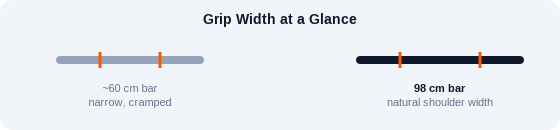
This matters because most people buy a resistance bar to train their chest, shoulders, and back — not to do an endless series of tricep-dominant presses. With a bar in the 55–65cm range, your hands land roughly 30–40cm apart, which is inside shoulder width for the average adult male and borderline for the average adult female. You end up pressing with your elbows tucked hard against your ribs, and the chest never fully engages.
At 98cm, you can place your hands 50–60cm apart — right around most people's natural pressing width — with room to adjust wider or narrower. That adjustability is the real advantage: you can run a wide-grip press for chest emphasis one set and a close-grip press for triceps the next, on the same bar.
Shoulder Comfort and Joint Angles
There's a biomechanical reason narrow pressing feels "off." When your hands are forced close together, your shoulders internally rotate and your elbows flare or tuck excessively to compensate. Over many reps, that awkward shoulder position can feel pinchy or unstable, especially for people with cranky shoulders.
A wider grip lets your upper arms sit at roughly 45 degrees from your torso at the bottom of the press — the position strength coaches have recommended for decades because it balances chest activation with shoulder joint comfort. You don't need a biomechanics degree to feel the difference: one set of presses on a too-short bar versus a 98cm bar, and your shoulders will vote clearly.
Rows: Width Gives You Back Thickness
The same logic applies in reverse for pulling. In a bent-over row, a wider grip lets you pull your elbows out and back, which brings the upper back — rhomboids, rear delts, mid-traps — into the movement. A narrow grip biases the lats and biceps instead.
Neither is "wrong" — a complete back needs both. But if your bar only allows a narrow grip, you're locked out of the wide-row variation entirely. The 98cm length gives you both options: hands wide for upper-back thickness, hands narrow for lat-focused rows.
The Barbell Comparison
For reference, an Olympic barbell is 220cm and a typical bench-press grip spans 70–80cm between the hands. Nobody expects a portable band bar to replicate a barbell exactly — but 98cm gets you meaningfully closer to real pressing and rowing mechanics than the 60cm travel bars that dominate the portable market. The band hooks sit farther out, the force lines run more vertically through your hands, and the whole movement feels less like a compromise.
How to Test Bar Length Before You Buy
If you already own a broomstick or a PVC pipe, you can feel the difference in thirty seconds. Mark 60cm on it with tape, grip it at that width, and mime a chest press. Then re-mark at 98cm and repeat. The wider position should feel immediately more stable and more "chest-like" — your elbows naturally settle into that 45-degree angle, and the movement feels like a press rather than a squeeze. It's a crude test, but it predicts the real thing surprisingly well.
Also check the product specs for how the 98cm is achieved. A one-piece 98cm bar won't fit in most luggage; a three-piece design gives you the same training length with travel-friendly breakdown. The joint quality matters here — look for deep, clean threading and a snug fit with no wobble when assembled. A bar that flexes or rattles at the joints undermines the very stability the length is supposed to provide.
What About Storage and Portability?
The obvious objection: a longer bar is harder to carry. That's why a 98cm bar works best as a three-piece design that breaks down into sections under 40cm. You get full-width mechanics during the workout and a package that fits in a travel bag or closet corner when you're done. Length only matters when it's assembled; the rest of the time it should disappear into its carry case.
Bottom line: if you're choosing between resistance bars, treat length as a primary spec, not a footnote. A 98cm (38.5") bar gives you natural grip width for presses, real options for rows, happier shoulders, and movements that actually feel like the exercises they're replacing. That's a lot of training quality hiding in a single number.
Put your knowledge into practice.
Find the bar set and accessories that fit your training routine.
Explore the training system