Resistance Bands vs. Free Weights: What the Research Says
The Wrong Question, Asked the Right Way
"Are resistance bands as good as weights?" is one of the most searched questions in home fitness — and one of the least useful, because it assumes strength training is a single thing. It's not. Strength is built by muscles producing force against resistance, and both elastic bands and free weights provide resistance. The real question is: how does the resistance differ, and what does that mean for your training?
This article sticks to established exercise-science principles — how muscles, levers, and resistance curves actually work — rather than cherry-picked study claims. No miracle findings, just mechanics.
Principle 1: Bands Give You Variable Resistance, Weights Give You Constant Resistance
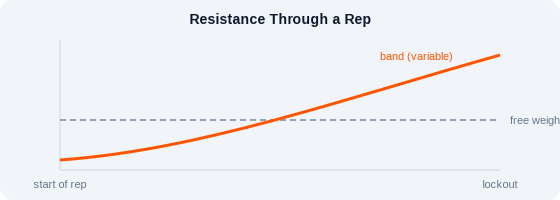
This is the fundamental difference. A dumbbell weighs the same at the bottom of a curl as at the top — gravity doesn't change. A band's resistance increases the further you stretch it. At the start of a chest press, the band is nearly slack; at lockout, it's pulling hard.
Why does that matter? Human strength isn't constant through a movement either. You're typically weakest at the bottom of a lift (the "sticking point") and strongest near lockout, where your joint angles give you better leverage. Variable resistance roughly matches this natural strength curve: lighter where you're weak, heavier where you're strong. That's not magic — it's just geometry working in your favor.
Principle 2: Bands Resist in Every Direction, Gravity Only Pulls Down
A dumbbell only resists vertically. That's why a standing bicep curl works but a "standing chest fly" with dumbbells does almost nothing — gravity is pulling the weights straight down, not outward. Bands resist along their own line of pull, which means you can load horizontal and diagonal movements: chest flies, woodchoppers, pallof presses, face pulls.
In practical terms, a band set gives you access to movement planes that would require cable machines in a gym. For a home trainee, that's a genuine expansion of the exercise menu, not a gimmick.
Principle 3: The Strength Curve Cuts Both Ways
Honesty requires the flip side. Because bands are lightest at the start of the movement, the stretched position — the bottom of a squat, the bottom of a press — gets less loading than it would with a free weight. The deep, stretched position is exactly where many lifters want significant tension for muscle growth.
Experienced band users compensate with simple tricks: pre-stretching the band before the rep begins (stepping wider, choking up on the band, or starting with the band already under tension), and choosing exercises where the geometry keeps tension through the full range. It works, but it takes a little setup awareness that a dumbbell doesn't demand.
Principle 4: Progressive Overload Works the Same Way
Muscles don't know what implement you're holding. They respond to mechanical tension, and progressive overload — gradually increasing the demand over time — is the mechanism of growth regardless of the tool. With bands, overload comes from stacking bands, shortening the band, slowing the tempo, or adding reps and sets. The physiology is identical; only the loading method changes.
Principle 5: Joints, Safety, and the Learning Curve
Two practical advantages of bands are well accepted among coaches. First, because resistance is lowest in the weakest joint positions, bands are generally gentler on joints during the learning phase — there's a reason physical therapists have used them for decades. Second, there's no weight to drop on your foot or fail on your chest, which makes training to near-failure safer when you're alone at home.
The trade-off: free weights give you exact, quantifiable loading (you know a 20kg dumbbell is 20kg), which makes programming simpler. Band "levels" are approximate, so tracking progress requires a bit more attention — note your band combinations and reps, and the ambiguity disappears.
So Which Should You Choose?
For most home trainees, this isn't either/or. Bands — especially a bar-based system like a 98cm resistance bar set — cover the fundamental push, pull, hinge, and squat patterns with joint-friendly variable resistance and a tiny storage footprint. Free weights offer precise loading and heavier absolute resistance for advanced lifters. Many experienced home-gym owners end up with both.
But if you're choosing one tool to start with, ask what constrains you: space, budget, joint comfort, and travel. If the answer to most of those is "yes, that's a problem," bands aren't the compromise option. For your situation, they're the right tool on the merits — and the exercise science backs that up without needing any exaggerated claims.
A final practical note: whichever tool you choose, the program matters more than the implement. Consistent progressive overload, adequate protein, sleep, and patience will build strength with bands, weights, or both. The best resistance tool is the one you'll actually use three times a week for the next year — so pick the one that fits your life, not the one that wins internet debates.
Put your knowledge into practice.
Find the bar set and accessories that fit your training routine.
Explore the training system