How to Set Up a Door Anchor Safely: Step-by-Step Guide
The Smallest Piece of Equipment Carries the Biggest Safety Job
A door anchor is a simple strap — usually a loop of heavy nylon webbing with a stopper ball or block on one end. You slide it through the gap on the hinge side of a door, close the door, and the stopper catches against the frame, giving you a fixed point to attach your resistance bands. It's brilliantly simple, which is exactly why it deserves respect: the entire load of your workout hangs on that one contact point.
Set up correctly, a door anchor is perfectly safe for typical band tensions. Set up carelessly, it's the most common source of band-training accidents — not because bands are dangerous, but because a slipping anchor turns stored elastic energy loose in an unpredictable direction. This guide walks you through doing it right, every time.
Step 1: Pick the Right Door
Not every door qualifies. Your anchor door should be:
- Solid and heavy. A solid-core interior door or any exterior door is ideal. Lightweight hollow-core doors can flex under load — if your door feels flimsy when you push it, pick another one.
- Opening away from you. The door must open away from the direction you'll be pulling. If you're doing rows facing the door, the door should open away from you, so your pulling force pushes it tighter into its frame rather than pulling it open toward you.
- Lockable, or in a room you can secure. The nightmare scenario is someone opening the door mid-set. Lock it, or put a clear "training in progress" barrier — a chair, a note, a wedged doorstop — so nobody walks in.
- With a clean frame gap. Check that the door closes fully with the anchor strap in place. If the latch won't catch because the strap is too thick, the door isn't suitable — a partially latched door can swing open under load.
Step 2: Place the Anchor on the Hinge Side
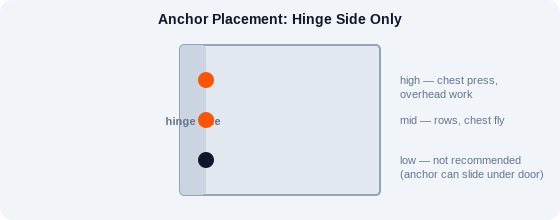
Open the door slightly and drape the strap over the top or side edge on the hinge side — the side with the hinges, not the handle. The stopper goes on the far side of the door; the loop stays on your side. Close the door firmly and check that it latches.
Why the hinge side? The hinges are the door's strongest mounting point. An anchor on the handle side puts leverage on the latch, which is the weakest part of the assembly. On the hinge side, your pulling force transfers directly into the frame.
Step 3: Set the Height for Your Exercise
- High (top of door): for overhead tricep extensions, lat pulldown-style movements, and high-to-low chops.
- Mid (chest height): for chest presses, rows, and chest flies — the most-used position.
- Low: generally avoid. An anchor near the floor can slide under the door gap when loaded. For low pulls, stand on your bands instead.
Step 4: The Pre-Flight Check (Every Single Session)
This takes thirty seconds and prevents nearly every anchor accident:
- Tug test. Attach your band and give it three firm pulls in the direction you'll be training — harder than your working sets. Watch the stopper side: any creeping or shifting means re-seat the anchor.
- Inspect the strap. Look for fraying, thinning, or cracked stitching on the webbing, especially where it bends over the door edge. If the webbing looks worn, replace the anchor — they're inexpensive.
- Check the door. Confirm it's fully latched and locked. Push on it. It shouldn't budge.
- Clear the area. Make sure nobody — kids, pets, roommates — can walk into the door's swing path or your training space mid-set.
What If the Anchor Slips Mid-Set?
If you ever feel the anchor shift during a rep: stop, control the band back to slack slowly (never just let go), and re-seat everything from Step 2. A slip is feedback, not failure — it usually means the door wasn't fully latched or the strap sat on the wrong side. Fix the setup, re-run the tug test, and continue.
When to Skip the Door Entirely
Door anchors are convenient, not mandatory. If you're in a hotel with flimsy doors, stand on your bands for rows, curls, and presses — a 98cm resistance bar set gives you plenty of standing options. If you're training heavy and want zero doubt, loop bands around a verified-sturdy post, a squat rack, or a ground-floor stair newel. The best anchor is the one you trust completely, because confidence in your setup is what lets you train hard without holding back.
One more habit worth building: re-check the anchor halfway through long sessions, especially if you're switching heights. Moving the strap from high to mid changes how it seats against the frame, and a quick tug test after each repositioning costs five seconds. Anchors rarely fail without warning — they creep first. Catching that creep early is the whole game.
Put your knowledge into practice.
Find the bar set and accessories that fit your training routine.
Explore the training system